
If you've spent any time in the Korean food corners of the internet, you've probably run into this story: Gordon Ramsay — the guy famous for screaming at chefs on television — takes one bite of Korean fried chicken and is so overwhelmed that he actually starts crying.
It's a great story. It's the kind of thing that makes you want to screenshot it and send it to three friends immediately. There's just one problem.
It doesn't appear to be true.
Gordon Ramsay Korean Fried Chicken: What Actually Happened
Before we get into what's fake, let's talk about what's real, because there's actually a lot of it. Ramsay's connection to Korean food isn't invented — it's just been exaggerated.
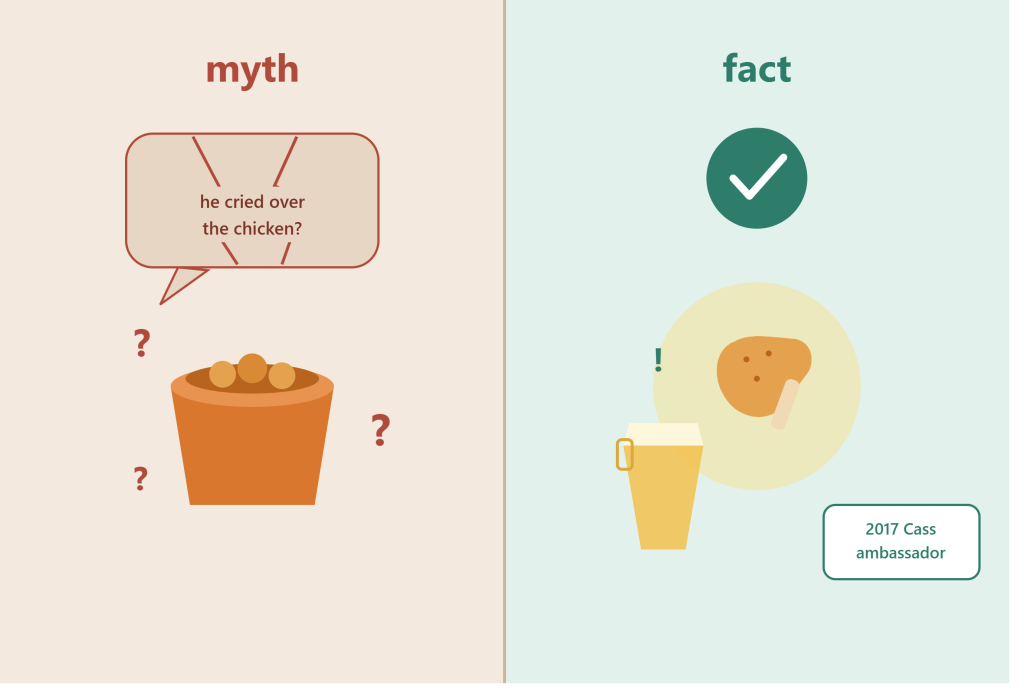
In September 2017, Ramsay was announced as the new brand ambassador for Cass, one of South Korea's best-known beer brands, owned by Oriental Brewery. According to a report from allkpop covering the campaign shoot, Ramsay spent time at a fried chicken restaurant tasting different flavors alongside Korean MasterChef contestant Austin Kang, and reacted enthusiastically to the food and beer pairing. He also visited Korea that same year and stopped by Gwangjang Market, a well-known traditional market in Seoul, where he tried tteokbokki, jeon, live octopus, and gimbap — including a moment where a street vendor hand-fed him a piece of gimbap, which reportedly went viral in Korea at the time, according to Korea JoongAng Daily's coverage of his trip.
One of the Cass commercials even has Ramsay sitting in front of a plate of Korean fried chicken, calling out to a server using the word "imo" — which literally means "aunt," but is commonly used in Korea as an informal, friendly way to address restaurant staff. That ambassador deal was also covered by Branding in Asia, and the resulting ad campaign got enough attention abroad that CNBC reported on the mixed reactions it got from Twitter users unconvinced that Ramsay genuinely enjoyed the beer. So yes: Gordon Ramsay, Korean fried chicken, and genuine enthusiasm are all part of the same real story.
What's missing from every source I could find is any actual evidence of him crying over it.
So Where Did the Crying Story Come From?
Here's where it gets interesting from a "how does the internet work" perspective. Gordon Ramsay has been a meme for over a decade. His theatrical meltdowns on shows like Hell's Kitchen have been turned into more reaction images than anyone could count. So the internet already had a shorthand for him: Ramsay plus food plus extreme emotion equals content that spreads.
Once you have a real photo — say, Ramsay looking delighted over a plate of Korean fried chicken — it doesn't take much for someone to slap a dramatic caption on it, and for that caption to get repeated so many times that people start remembering it as if it were part of the original event. That's almost certainly what happened here. There's a real photo, a real reaction, and a fictional detail that got glued onto it somewhere along the way and never let go.
Why This Kind of Story Feels So Believable (and Why We Fall for It)
There's a reason food-related celebrity myths like this stick around: they combine two things people already want to believe. First, that Korean food is genuinely good enough to break through even the most jaded palate — which, honestly, isn't a stretch. Second, that we get to watch someone larger-than-life have an unguarded, human moment. Put those together and you get a story that's emotionally satisfying whether or not it's technically accurate. It's the food-blog equivalent of a tearjerker movie trailer — you know it's manufactured, but it still gets you a little.
How This Compares to American Celebrity Food Folklore
This isn't a uniquely Korean phenomenon, for what it's worth. American food culture has its own long history of celebrity food myths that outgrew their original facts — a celebrity supposedly eating the exact same meal every single day, a chef supposedly banning a customer for life over a minor request, a star supposedly crying over a childhood dish on camera. The pattern is always the same: a real, smaller moment gets picked up, repeated, and slowly exaggerated until the exaggerated version becomes the one everyone remembers. Korean fried chicken and Gordon Ramsay just happen to be this particular decade's version of that very old internet habit.
What makes food myths especially sticky, compared to other celebrity rumors, is that they're low-stakes and easy to picture. Nobody has much reason to fact-check a story about a chef enjoying chicken a little too much — it's not scandalous, it's not really damaging to anyone, and it's genuinely fun to imagine. That combination of harmlessness and vividness is exactly why a claim like this can travel further and last longer than something more consequential would. It's also worth noting that Ramsay's public persona practically invites this kind of storytelling — he's spent two decades being filmed having big, unfiltered reactions to food, so audiences are primed to believe almost any dramatic reaction attributed to him, true or not.
The Real Story Korean Fried Chicken Doesn't Need Borrowed From
Here's the thing — Korean fried chicken doesn't actually need a celebrity crying over it to be a legitimately great story. Its real history is more than enough on its own.
Fried chicken as a concept was introduced to Korea in the years following the Korean War in the 1950s, when American troops stationed in the country brought their own fried chicken traditions with them. Korean cooks and vendors took the idea and ran with it, and by the 1970s and 80s, the now-iconic double-frying method had become the standard — frying the chicken once at a lower temperature to cook it through, then again at a higher temperature for that signature shattering crunch. It's also part of why Korean fried chicken tends to feel lighter and less greasy than its American counterpart.
Then there's chimaek — the pairing of chikin (chicken) and maekju (beer) — which really took off as a cultural phenomenon around the 2002 World Cup, co-hosted by South Korea and Japan, when crowds gathered around televisions with chicken and beer to cheer on the national team. That combination stuck, and decades later it's still one of the most beloved ways to eat in Korea, whether you're celebrating something or just getting through a Tuesday.
None of that required a viral meme to be true. It's just genuinely a good story.
Honestly, this is a pattern I keep running into with Korean food stories that get big online — somewhere along the way, a real, interesting fact gets treated like it's not dramatic enough on its own, so someone adds a flourish, and the flourish is what actually goes viral. Korean fried chicken doesn't have that problem. Between the war-era origins, the decades of trial and error that led to the double-fry method, and an entire drinking culture built around it, the real story was always going to be more than enough.
How to Actually Experience Real Korean Fried Chicken in the U.S.
If this whole story has you craving the real thing, skip the myth and go straight to the source. A few tips:
- Look for Korean fried chicken chains near you. Brands like BBQ Chicken, Kyochon, and bb.q Chicken have locations across the U.S., especially in and around Koreatowns in major cities.
- Order two flavors to compare. Soy garlic and yangnyeom (sweet and spicy) are the two most classic options, and trying both side by side is the best way to understand what makes Korean fried chicken different from what you might be used to.
- Do the chimaek thing properly. A light, crisp lager is the traditional pairing — nothing too heavy or bitter, since the point is to let the chicken's crunch and sauce do the talking.
- Watch the actual commercial if you're curious. The real Cass beer ads featuring Ramsay are still up on YouTube, and they're honestly more entertaining than the fake crying story — no embellishment required.
At the end of the day, maybe the better question was never "did Gordon Ramsay cry over Korean fried chicken." It's "why does Korean fried chicken make so many people, celebrity chefs included, a little obsessed with it." That's the story actually worth telling — and it happens to be one hundred percent true.
Gordon Ramsay Korean Fried Chicken FAQ
Did Gordon Ramsay Really Cry Over Korean Fried Chicken?
There's no reliable evidence supporting the viral claim that Gordon Ramsay cried after eating Korean fried chicken. It appears to be internet exaggeration built on top of a real, more low-key positive reaction.
What Is Gordon Ramsay's Actual Connection to Korean Food?
Ramsay became a brand ambassador for Cass beer in 2017 and appeared in commercials featuring Korean fried chicken. That same year, he also visited Seoul's Gwangjang Market and tried several traditional Korean dishes.
Why Is Korean Fried Chicken Different From American Fried Chicken?
Korean fried chicken is typically double-fried, which makes the coating thinner, crunchier, and less greasy compared to the thicker-battered, single-fried style common in American fried chicken.
What Is Chimaek?
Chimaek is the Korean tradition of pairing fried chicken (chikin) with beer (maekju). It became especially popular during the 2002 World Cup and remains a staple of Korean social dining.