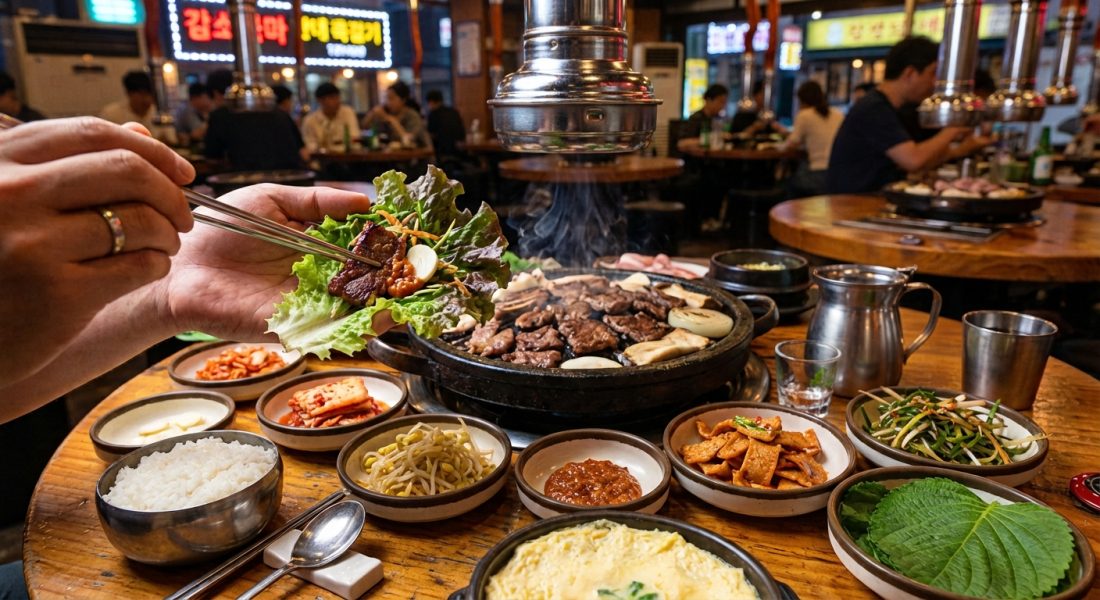

A few years back, I took an American friend to a Korean BBQ place for the first time. We sat down, and within about two minutes, ten little dishes of banchan showed up on the table, followed by lettuce and perilla leaves, and then — raw meat, on a grill, right in front of us. I will never forget the look on her face. "Wait... am I supposed to cook this myself?" For the rest of the meal, she just watched me and copied whatever I did. When to flip the meat, when to eat the side dishes, what the lettuce was even for — she had no idea, and honestly, why would she?
That night made me realize something. All the things that feel completely automatic to me are, to someone experiencing it for the first time, basically an entire rulebook with no instructions included. So today, I'm breaking down exactly what to expect at Korean BBQ, from the second you sit down to the moment the check arrives.
The History of Korean BBQ
Korean BBQ's roots go back a lot further than you'd guess — all the way to the Goguryeo era, between 37 BCE and 668 CE. Back then, there was a dish called maekjeok, marinated skewered meat grilled over fire, believed to have come from the nomadic Maek people. Over the centuries, that evolved into what we now know as bulgogi.
During the Joseon Dynasty, it was known as neobiani ("thinly spread meat"), and it wasn't exactly an everyday dish. Cattle slaughter was heavily restricted by law at the time, which meant beef, and by extension this dish, was mostly reserved for royalty and the nobility. It took a long time before regular people could enjoy grilled beef freely.
The tabletop-grilling format we know today — cook it yourself, right at the table — became widespread in the 20th century, especially after the Korean War. And here's a fun detail: the "LA galbi" you'll spot on menus at Korean restaurants across the U.S. — the short ribs cut thin across the bone — was actually developed by Korean immigrants in America. Cutting the ribs that way meant faster cooking and a cheaper cut of meat, which made it popular in Korean immigrant communities before catching on with American diners too. So a good chunk of the Korean BBQ you're eating in the U.S. has already gone through one round of American reinvention.
So What Exactly Is Korean BBQ?
At its core, Korean BBQ comes down to one thing: you cook the meat yourself, right at the table. Unlike an American steakhouse, where everything arrives fully cooked from the kitchen, here you (or your server) do the grilling as you go. The usual suspects are pork belly (samgyeopsal), beef short ribs (galbi), and pork shoulder/collar (moksal). Each cut cooks differently and has its own texture, so there's genuinely a bit of a learned skill to doing it right.
Why Korean BBQ Hits Different
One thing that sets Korean BBQ apart from American barbecue is that it's not just about the meat. Thanks to ssam culture — wrapping meat in lettuce or perilla leaves — you end up getting protein and vegetables in the same bite, every time. Add garlic, chili peppers, and doenjang (fermented soybean paste) into the wrap, and you get a meal that's more balanced, and more flavorful, than it has any right to be.
And maybe more importantly, this isn't food you eat alone. Everyone's gathered around the same grill — someone's cutting the meat with kitchen scissors, someone's refilling the lettuce, someone's arguing about whether it's done yet. The whole process practically forces conversation and interaction. That's probably why Korean BBQ spots do so well in the U.S., even outside Korean neighborhoods — people aren't just going for the food. They're going for the whole experience of cooking and eating together.
There's also a drinking culture wrapped into all of this. Soju — Korea's clear, mild rice or grain spirit — is the classic pairing with grilled meat, and pouring it for each other (rather than pouring your own) is part of the ritual. You don't need to drink to enjoy Korean BBQ, but don't be surprised if a bottle of soju or a round of beer shows up at the table without anyone really asking for it. It's just part of the package.
Korean BBQ vs. American Barbecue
Line them up side by side and a few clear differences show up:
- Who does the cooking: American BBQ or steakhouse food is cooked in a kitchen or by a pitmaster, and it shows up ready to eat. Korean BBQ has you cooking at the table, sometimes with help from your server.
- How you eat it: American steak gets cut with a fork and knife, plate-style. Korean BBQ gets wrapped in lettuce with meat, banchan, and ssamjang, and eaten in one bite, by hand.
- What comes with it: American BBQ usually comes with one or two sides. Korean BBQ comes with a whole table full of banchan.
- The social piece: American BBQ is social too, sure, but Korean BBQ makes the actual act of grilling together part of the interaction, not just the eating.
How Korean BBQ Won Over America
Korean BBQ's popularity in the U.S. didn't happen overnight, and it's worth knowing how it got here. A lot of it tracks with the rise of Hallyu — the "Korean Wave" of K-pop and Korean dramas — which picked up serious momentum in the U.S. in the 1990s and 2000s and brought a broader curiosity about Korean culture along with it, food included.
Korean American chefs played a huge role too. Chefs like Roy Choi and David Chang took dishes like bulgogi and galbi and worked them into formats Americans already loved — think bulgogi tacos and galbi sliders — which made Korean flavors feel familiar and approachable rather than intimidating. And the demand has kept climbing since: Korean food exports topped $12.1 billion globally in 2023, according to reporting from The Korea Times, a sign that appetite for Korean cuisine, Korean BBQ very much included, isn't slowing down anytime soon.
How to Actually Enjoy Korean BBQ: A Beginner's Guide
Ready to go? Here's how to walk in looking like you've done this before.
- Don't panic when the raw meat shows up. Most places will have your server start the grilling for you, or at least help with the first few pieces. Don't flip or cut anything on your own until you've watched how it's done — either by the staff or whoever you're with.
- Different cuts cook at different speeds. Pork belly is thick and fatty, so it needs more time. Galbi cooks faster. You'll know it's ready when it's browned on the outside and the juices are visibly running.
- Learn to build a ssam. Lay a lettuce or perilla leaf flat in your palm, add a piece of meat, a little rice if you want, and a dab of ssamjang, garlic, or chili. Then eat it in one bite. It doesn't need to fit perfectly — an oversized bite is completely normal here.
- Dig into the banchan right away. These aren't served course by course — they're all on the table from the start, so feel free to grab whatever looks good whenever you want. Most places will refill them for free, too.
- Use the sauces strategically. Sesame oil and salt work well with milder cuts, while ssamjang brings more punch for when you want a bolder bite. Try both and see what you like.
- If it's your first time, start simple. Pork belly or pork shoulder are safe, low-risk choices to start with. Save galbi, which tends to run pricier, for your next visit once you've got the basics down.
Korean BBQ can look like a lot the first time you sit down to it — the grill, the ten little dishes, the raw meat staring back at you. But once you know the rhythm, it's honestly one of the most fun, most social ways to eat out there. Go in expecting a little chaos, a little smoke, and a lot of good food, and you'll do just fine.
Frequently Asked Questions About Korean BBQ
What Is Korean BBQ, Exactly?
Korean BBQ (gogi-gui) is a Korean dining tradition where various cuts of meat are grilled at the table, usually over charcoal or gas, and eaten with banchan, rice, and lettuce wraps.
What Should I Order My First Time at Korean BBQ?
Pork belly (samgyeopsal) and pork shoulder (moksal) are great beginner-friendly choices at Korean BBQ — they're forgiving to cook and hard to mess up.
Do I Have to Cook the Meat Myself at Korean BBQ?
Not always. Many Korean BBQ restaurants have servers who will start the grilling for you or step in to help, especially if it's clear you're new to it.
What Is a Ssam in Korean BBQ?
A ssam is a lettuce or perilla leaf wrap filled with grilled meat, rice, and sauce or seasonings, eaten in a single bite. It's the classic way to eat Korean BBQ.