
Let me set the scene: I'm fourteen years old, standing in front of my bedroom mirror, trying (and mostly failing) to nail the choreography to "Beat It" for my high school festival performance. My friends and I rehearsed those synchronized moves over and over until our legs gave out. Michael Jackson wasn't just a pop star to teenage me — he was basically a religion. So when I found out, years later, that the King of Pop once visited Korea and fell head over sequined glove for one of our most beloved comfort foods, I knew I had to write about it.
That food? Bibimbap.
Yes, really — the Michael Jackson bibimbap story is one of my favorite pieces of K-food trivia, and today I'm sharing both the tale and my own homemade version of the dish.
The Michael Jackson Bibimbap Story: More Than Just a Rumor

Here's where the story gets more interesting than I expected. According to a Yonhap News report from November 20, 1997, Michael Jackson had just wrapped up a private two-night stay at Muju Resort in Korea and was heading back to Seoul. Around 2 a.m., he woke up and reportedly asked his staff to prepare bibimbap for him — and finished the entire bowl.
That wasn't a one-time thing, either. During his stay at Seoul's Shilla Hotel, the hotel reportedly catered to his specific preferences: since Jackson didn't eat meat, they swapped in seasonal mountain vegetables — things like squash, shiitake mushrooms, wild greens, and fernbrake — instead of meat. And since he wasn't used to spicy food, they used soy sauce instead of the traditional spicy gochujang. The hotel even created a dish named in his honor: "MJ Bibimbap."
Now, I'll be straight with you: I couldn't track down an actual interview where Michael Jackson himself says the words "I love bibimbap" on camera. This story comes from Korean news reporting and hotel accounts rather than his own words. But unlike a lot of celebrity food folklore, this one actually has a wire service report behind it — Yonhap News is Korea's equivalent of the Associated Press, not just a blog rumor. So consider this "well-documented Korean media story" rather than "confirmed straight from his own mouth" — which, honestly, is about as solid as celebrity food trivia gets.
Whether or not Michael Jackson ever declared his love for bibimbap in an interview, the story alone helped put this humble rice bowl on the global map decades before K-food went mainstream in the West. And once you understand what bibimbap actually is, you'll get why the story caught on so easily — it's the kind of dish that converts people on the first bite.
So What Exactly Is Bibimbap?
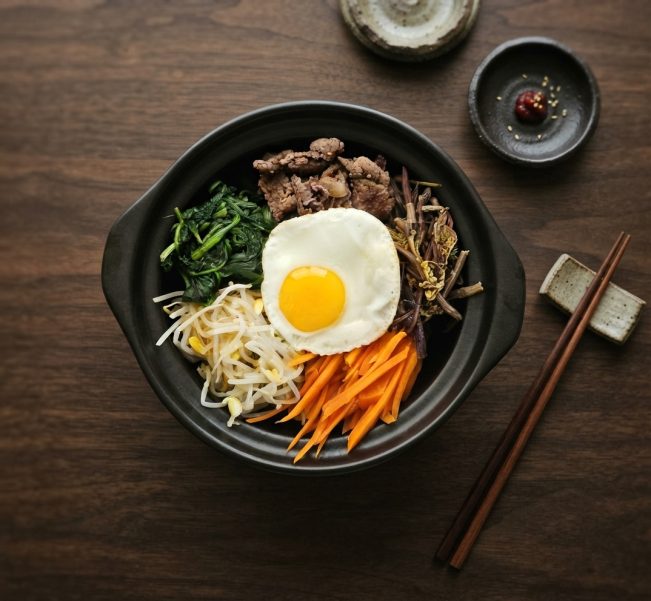
Bibimbap literally means "mixed rice" (from bibida, "to mix"), and it does exactly what it says on the tin: a bowl of warm rice topped with an array of seasoned vegetables, protein, a fried or raw egg, and a generous dollop of gochujang (Korean fermented chili paste), all mixed together right before eating.
Its roots trace back to the Joseon Dynasty (1392–1910), specifically to Seotdal Geumeum, Korean Lunar New Year's Eve. Families would take whatever food was left over from the year's cooking and mix it all together with rice rather than let anything go to waste — a dish called goldongban. Waste-not-want-not energy, 500 years before "zero waste" became a hashtag. The dish we now know as bibimbap didn't officially show up in cookbooks until the late 1800s, and today, the city of Jeonju is considered its spiritual home, hosting an entire festival dedicated to it every October.
Why Your Body Will Thank You
Bibimbap isn't just delicious — it's basically a nutritionist's fever dream in bowl form. You've got:
- Carbs from the rice for energy
- Fiber and vitamins from a rainbow of vegetables (bean sprouts, spinach, bracken fern, carrots — take your pick)
- Protein from beef and egg
- Capsaicin from the gochujang, which has been linked to metabolism benefits
Because it packs in so many small portions of different vegetables, bibimbap makes it almost effortless to hit your daily veggie quota without even trying. There's an old (and admittedly unverified) saying that the secret to Korea's long-living elders is a lifetime of bibimbap — take that with a grain of salt, but it's not exactly a stretch to believe a bowl this balanced is doing something right.
Bibimbap vs. Your Average American Grain Bowl
If you've ever ordered a burrito bowl at Chipotle or a build-your-own bowl at Sweetgreen, you already understand the basic concept — rice or grains, veggies, protein, sauce, mix, eat. But bibimbap has a few tricks American bowls don't:
- You're the mixologist. Half the fun of bibimbap is physically stirring everything together yourself before the first bite. It's interactive in a way most American bowls aren't — think of it as the difference between assembling your own taco versus eating a pre-made one.
- Gochujang isn't just a hot sauce. Unlike most American hot sauces, which are vinegar-based, gochujang is fermented — which means it brings a deep, savory funk alongside the heat. It's less "add spice" and more "add an entire flavor dimension."
- The sizzle factor. When bibimbap is served in a hot stone bowl (dolsot), the rice touching the sides crisps up into a golden, crunchy layer while you mix. It's basically nature's way of giving you dessert-level crunch in a savory dish, and Americans who try it for the first time tend to lose their minds a little.
My Homemade Bibimbap Recipe
Vegetables
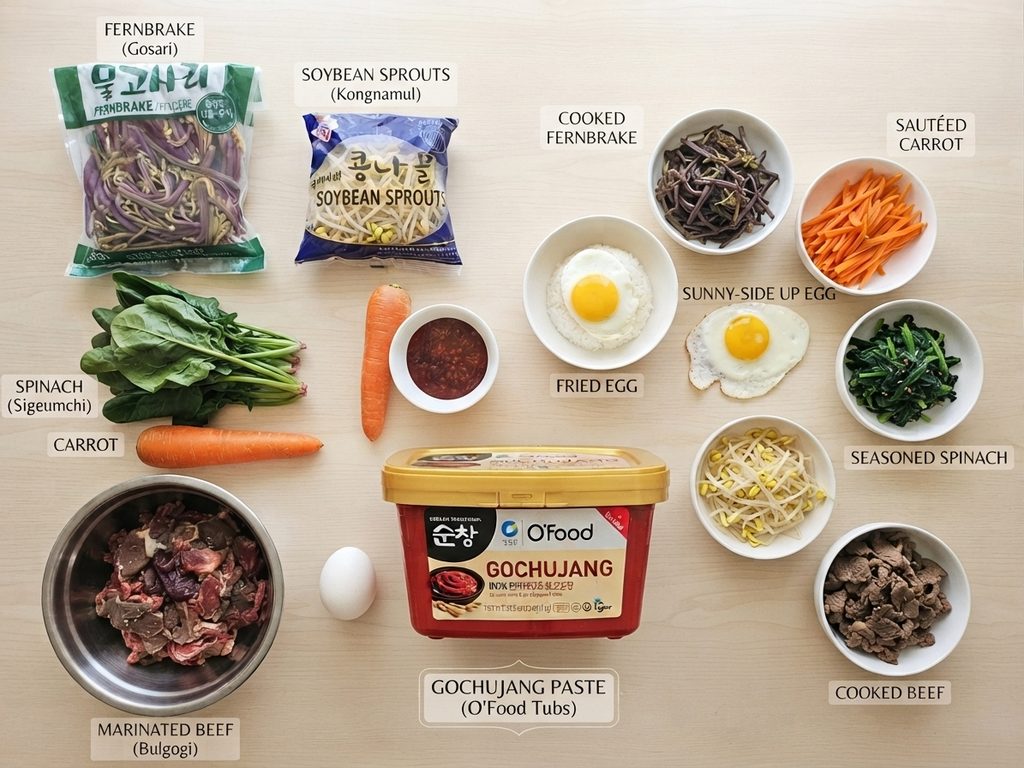
- Bean sprouts, spinach, bracken fern (gosari), and carrots — as much as you'd like
Bulgogi-Style Beef (for the marinade, based on 1 lb sirloin)
- 1/2 onion, thinly sliced
- 2 tbsp minced garlic
- A drizzle of sesame oil
- A pinch of toasted sesame seeds
- 2 tbsp sugar
- 4 tbsp soy sauce
- 3 tbsp water
Bibim Sauce (the magic drizzle)
- 2 tbsp gochujang
- 1 tbsp sesame oil
- 1 clove garlic, minced
- A sprinkle of sesame seeds
- 1.5 tbsp sugar
Instructions
- Wash all your vegetables thoroughly.
- Boil the bean sprouts, covered, for 15 minutes.
- Blanch the spinach briefly in salted boiling water, uncovered.
- Cut the bracken fern into 3-inch pieces and boil for about 3 minutes.
- Drain everything and squeeze out excess water firmly.
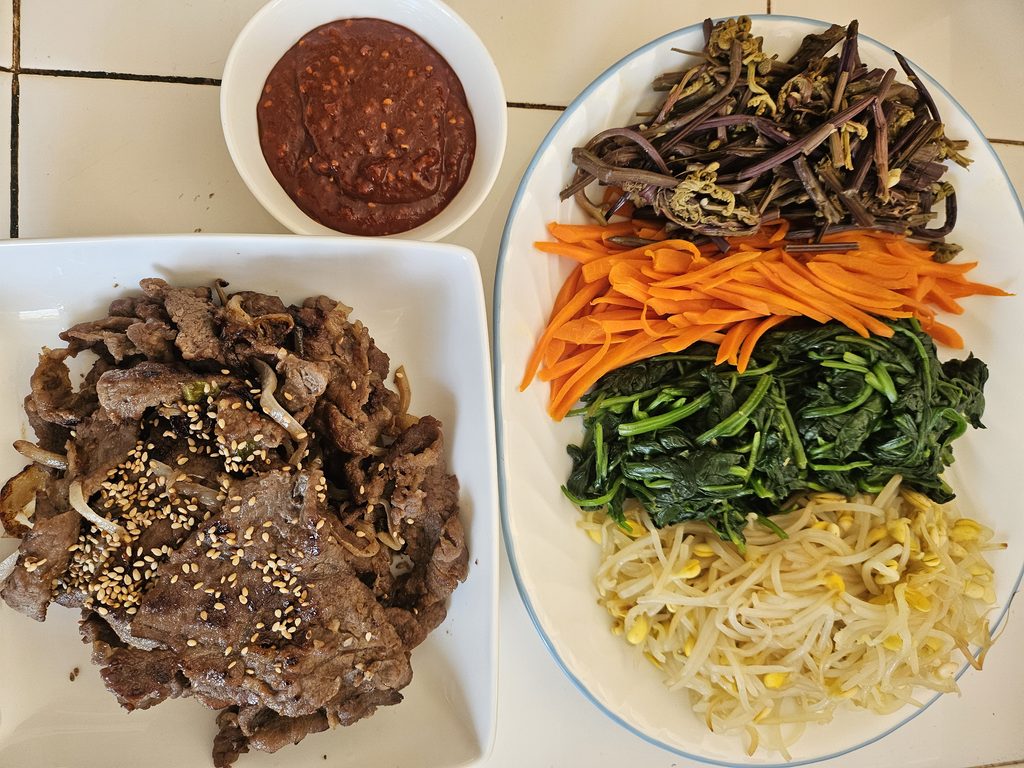
- Season the bean sprouts with sesame oil, salt, and garlic. Season the spinach with a splash of soy sauce, sesame oil, and garlic. Season the bracken fern with two spoonfuls of soy sauce, garlic, and sesame oil.
- Sauté the julienned carrots in a lightly oiled pan, then sauté the bracken fern as well.
- Cook the marinated beef in the same pan until done.
- Whisk together the gochujang, sesame oil, garlic, sesame seeds, and sugar to make your bibim sauce.
- Layer your rice with the vegetables and beef, top with a fried egg, and finish with a generous spoonful of bibim sauce. (Extra sesame oil or sesame seeds never hurt anyone.)
- Since this makes a generous amount of beef, chop a little for your bowl and save the rest to enjoy as bulgogi on its own — you're welcome.
Bringing Bibimbap Into Your American Kitchen
- Most Korean or Asian grocery stores carry gochujang, sesame oil, and pre-prepped vegetables if you want to skip a few steps.
- No dolsot (stone bowl)? A well-heated cast iron skillet gets you shockingly close to that crispy-bottom magic.
- Skip the beef and egg for an easy, fully plant-based version — bibimbap is naturally very vegetarian-and-vegan-adaptable.
Questions Americans Always Ask Me About Bibimbap
Is gochujang really spicy? It has a kick, but it's more "pleasantly warm" than "call 911." Start with less and add more to taste — nobody's judging you either way.
Is putting a raw or runny egg on top actually safe? Totally standard practice, and most people use a fried egg with a runny yolk (which acts like a sauce once you mix it in) rather than fully raw. If you're extra cautious, just cook it a bit more — the dish doesn't mind.
Should I start with bibimbap or bulgogi if I'm new to Korean food? Honestly? Make both — my recipe above basically gets you there in one shot.
Do I need a stone bowl to make this at home? Nope. A regular bowl works fine; a hot cast iron pan just gets you bonus crispy-rice points.
Can I make this gluten-free or vegan? Yes and yes — just double-check your gochujang and soy sauce brands (some contain wheat) and swap out the beef and egg for tofu or extra veggies.
So, legend or not, Michael Jackson's rumored bibimbap obsession says something true: this is a dish that's genuinely easy to fall in love with, whether you're the King of Pop or just someone standing in their kitchen in sweatpants, mixing rice with a spoon and feeling very accomplished about it. Give it a try — I promise it's worth the hype, moonwalk optional.