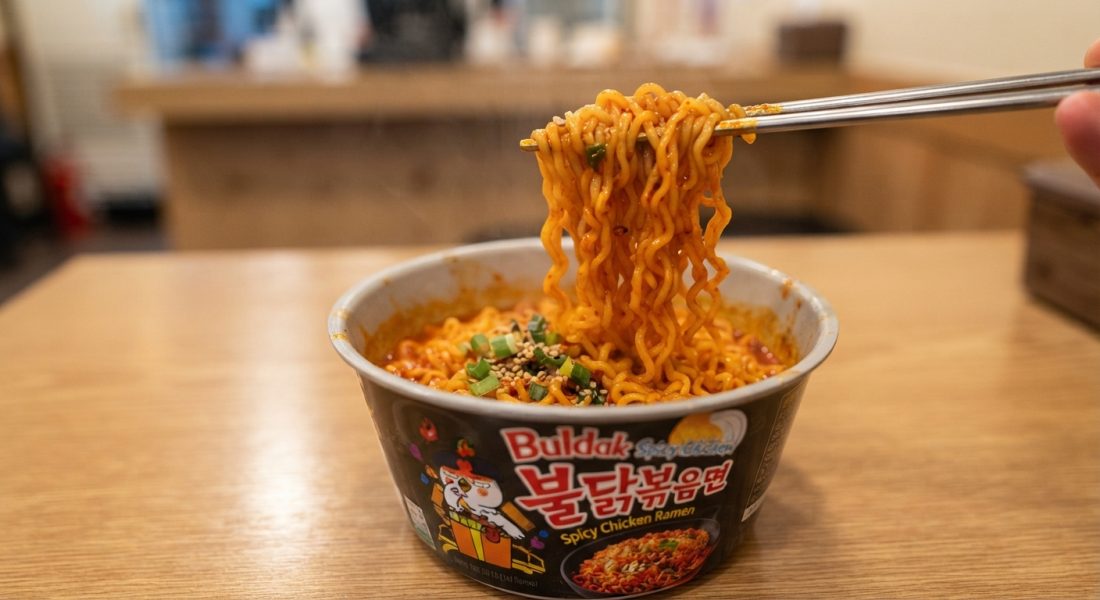

I need to make a confession before we start: I am, culinarily speaking, a Shin Ramyun loyalist. If you opened my pantry right now, you'd find a small mountain of the red packets, because I am the kind of person who could eat Nongshim's Shin Ramyun on repeat for a week and not once complain. So it genuinely pains me a little to write this post, because I have to tell you about a different Korean ramen — one that, in some very real ways, has quietly become an even bigger deal than my beloved Shin Ramyun. Its name is Buldak Bokkeummyeon, and if you've spent any time on YouTube or TikTok in the last decade, you've almost certainly seen someone crying, sweating, or frantically chugging milk because of it.
Korean palates, generally speaking, run spicy. Kimchi has heat built into it from childhood. A soup or stew without a healthy dose of gochugaru (Korean chili flakes) practically feels incomplete. I say this as someone who genuinely loves spicy food and doesn't consider that a particularly unusual trait among Koreans — it's closer to the baseline. So even to spice-hardened people like me, the sheer scale of Buldak's global takeover has been a little startling.This wasn't supposed to happen to a Korean instant noodle. And yet, here we are — Buldak fire noodles have somehow become one of the most talked-about spicy Korean noodles on the planet.
What Exactly Is Buldak Fire Noodles??
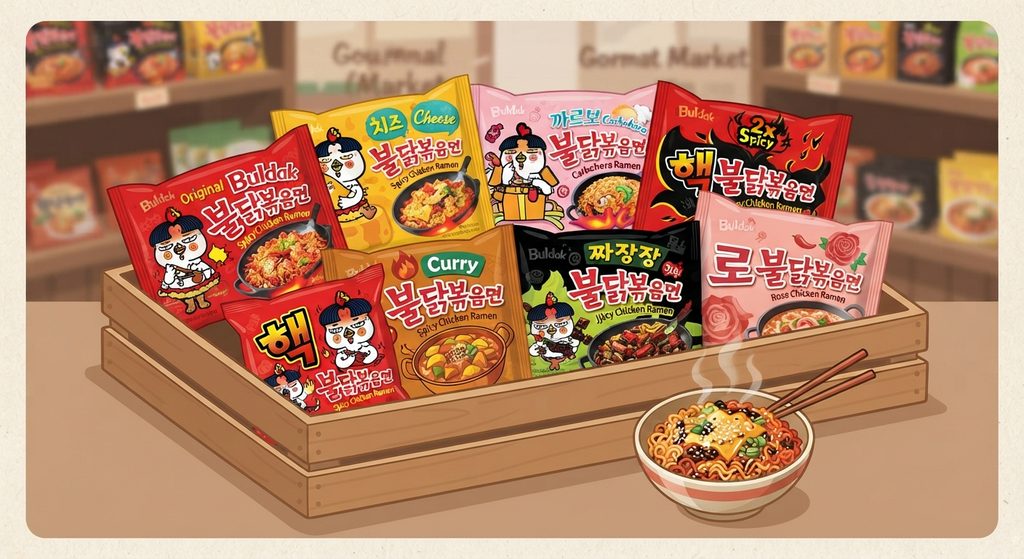
Buldak Bokkeummyeon (translating roughly to "fire chicken stir-fried noodles") is a broth-free, extra-spicy stir-fried ramen made by Samyang Foods, launched in April 2012. The origin story is almost accidental: Kim Jung-soo, then a member of Samyang's sales team and now the company's CEO, tried an intensely spicy chicken stir-fry dish at a restaurant back in 2010 and became convinced Samyang needed to turn that flavor into an instant noodle. The original packet clocks in at 4,404 Scoville heat units — already well above your average spicy ramen. Samyang didn't stop there: the "Nuclear" version (Hek-Buldak) doubles that heat to roughly 8,706 Scoville units, officially earning its reputation as one of the spiciest instant noodles sold anywhere. Over the years, the lineup has exploded into carbonara, jjajang (black bean sauce), curry, and stew variations, turning Buldak from a single spicy product into an entire flavor platform.
How the Fire Noodle Challenge Actually Started
Here's the part of the story most people don't know: Buldak's global explosion wasn't a marketing campaign. It was one video. In February 2014, a British YouTuber running a channel called "Korean Englishman" — host Josh Carrott — filmed his own father and a group of friends attempting to eat Buldak without drinking any water. The results were exactly what you'd expect: gasping, sweating, tears, a mad scramble for milk. The video went viral, and the "Fire Noodle Challenge" was born as an entire genre of content. Copycat videos flooded YouTube by the hundreds of thousands, then spread to Vine, Instagram, and eventually TikTok. The format got a second massive wind in 2019, when American competitive eater Matt Stonie posted a video of himself eating fifteen packs of Buldak in one sitting — a video that's racked up well over 140 million views and remains one of the most-watched food videos on the platform. At this point, there are literally millions of Fire Noodle Challenge videos on YouTube alone. The heat was always the hook, but the real content was watching normal people fail spectacularly at handling it.
How Buldak Became an American Cultural Event
If the original Fire Noodle Challenge got Buldak onto the map, a handful of very specific moments turned it into a full-blown obsession in the U.S.
The biggest one arrived in March 2024, when Cardi B posted a TikTok with food reviewer Keith Lee, trying Buldak's carbonara flavor. She told viewers she'd heard so much about it on social media that she'd driven — or rather, been driven — 30 minutes out of her way just to track it down at an H Mart. That single video contributed to a roughly 30% jump in Samyang's stock price and a reported 50% increase in sales. One celebrity, one bowl of noodles, one very real business impact.
Then, just a few months later, the opposite kind of headline hit: in June 2024, Danish food safety authorities recalled three Buldak varieties, warning that their capsaicin levels were high enough to pose a risk of "acute poisoning." The story got picked up everywhere — the BBC, The Guardian, The Washington Post — and, predictably, backfired spectacularly as a deterrent. Google searches for Buldak spiked worldwide, driven by exactly the reaction you'd expect: "wait, now I have to try the noodles that got banned." (Two of the three flavors were later cleared and returned to Danish shelves; the spiciest of the three remains off-limits there.)
On TikTok, an entire subculture formed around "surviving" Buldak — some creators racing through a bowl with no water in sight, others sharing their own hacks for taming the heat with cheese, cream, or a splash of milk stirred right into the sauce. And the retail story tells its own version of the same arc: Buldak used to be something you'd only find tucked into the noodle aisle at H Mart or another Korean grocery store. Now it sits right on the shelf at Walmart and Costco alongside every other mainstream instant noodle brand — proof that this stopped being a niche Korean import a while ago and became a genuine pantry staple for American shoppers.
The Ramen That Actually Overtook Shin Ramyun
Now, back to my personal heartbreak. If you'd told me a decade ago that a "gimmick" spicy noodle would end up rivaling Shin Ramyun's dominance, I wouldn't have believed you. But the numbers back it up in a way that's hard to argue with. In September 2024, Samyang Foods overtook Nongshim — Shin Ramyun's parent company — in stock market valuation for the first time in roughly three decades, a shift driven almost entirely by Buldak's runaway success overseas. More recently, brand reputation surveys have shown Buldak actually surpassing Shin Ramyun as Korea's most talked-about ramen brand. To be fair, Nongshim still pulls in more total domestic revenue than Samyang overall — Shin Ramyun hasn't lost its crown at the Korean dinner table. But when it comes to global recognition, the title of "the Korean ramen the world knows" now unquestionably belongs to Buldak.
Is Buldak Actually Good for You?
Let's be honest, nobody eats Buldak thinking it's a health food, and neither should you. But it's worth understanding what's actually happening in your mouth and stomach. The heat comes from capsaicin, the same compound that makes chili peppers spicy, and it's traditionally believed in Korea to boost metabolism and circulation — though it's worth noting that's more folk wisdom than a settled medical fact, so take it with the appropriate grain of salt. What is medically well-established is that eating extremely spicy food quickly, especially on an empty stomach, can irritate your stomach lining and trigger genuine discomfort — which, if you've watched enough Fire Noodle Challenge videos, you already knew from the visual evidence alone.
Buldak vs. America's Own Spice Challenge Culture
If you're an American reading this thinking "wait, we already had this," you're not wrong. The U.S. has its own long tradition of spice-based internet content — the Ghost Pepper Challenge, the hot wing gauntlet on shows like Hot Ones, the whole genre of "last one to tap out wins" spicy food content. Buldak didn't invent extreme-spice internet culture; it slotted neatly into a format Americans already loved, but brought something genuinely new to the table: an exotic, distinctly Korean flavor profile wrapped in a convenient, cheap, shelf-stable instant noodle format. It was spicy-food content creators' dream ingredient — accessible, affordable, and visually dramatic in a bowl.
How to Enjoy (or Survive) Buldak in the U.S.
If you're ready to try one of the most famous spicy Korean noodles for yourself, here's where to start
- Where to find it: H Mart, Walmart, Costco, and Amazon all carry Buldak now — it's genuinely easy to find, which is part of why the challenge spread so fast.
- If it's your first time: Start with the original red packet before you even think about the Nuclear version. Seriously. There's no prize for skipping straight to the hardest mode.
- Keep dairy nearby: Milk or yogurt genuinely helps cut the heat, since casein (a milk protein) binds to capsaicin better than water does. Water alone will not save you.
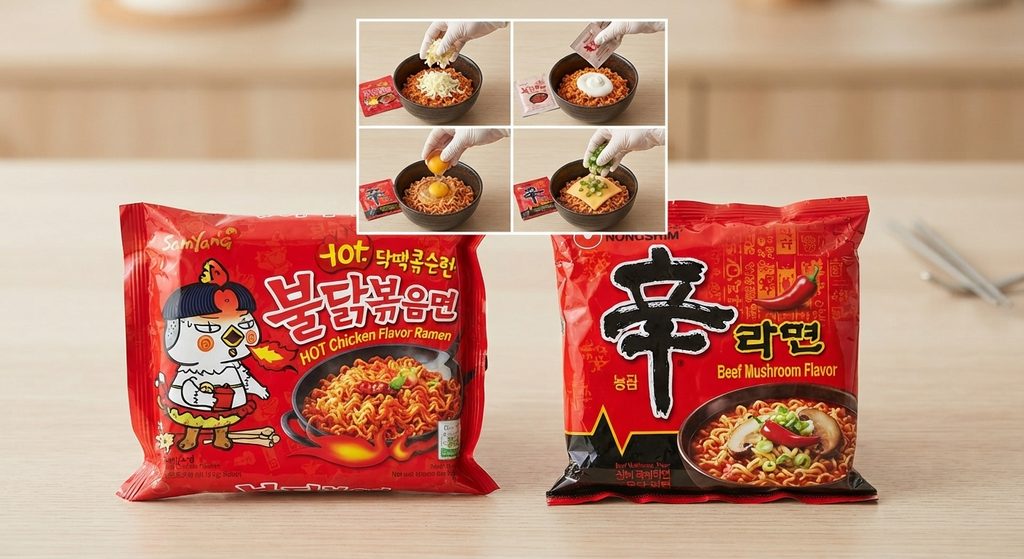
- If you actually just want to enjoy it (not challenge it): Do what Koreans do and doctor it up — a fried egg on top, a slice of cheese melted in, or a drizzle of sesame oil all mellow out the heat while keeping the flavor.
At the end of the day, I'll probably always reach for Shin Ramyun first when I'm just hungry and want comfort food. But I have to give Buldak its due: it did something no Korean noodle had done before — it turned a bowl of ramen into a piece of internet culture that millions of people, most of whom had never heard of Korean food before, willingly subjected themselves to on camera. That's not just a spicy noodle. That's a genuine cultural export, and honestly, a little bit of a miracle.
Frequently Asked Questions About Buldak
How spicy is Buldak fire noodles?
The original packet measures about 4,404 Scoville heat units, while the "Nuclear" (Hek-Buldak) version roughly doubles that to around 8,706 Scoville units, making it one of the spiciest instant noodles sold anywhere.
Who started the Fire Noodle Challenge?
British YouTuber Josh Carrott, host of the channel "Korean Englishman," posted the original viral video in February 2014, filming his father and friends attempting to eat Buldak without water.
Is Buldak banned in Denmark?
Not entirely. Denmark recalled three Buldak varieties in 2024 over high capsaicin levels; two were later cleared and returned to shelves, while the spiciest variety remains restricted.
Where can I buy Buldak noodles in the U.S.?
Buldak is now widely available at H Mart, Walmart, Costco, and Amazon, in addition to most Korean and Asian grocery stores.
Is Buldak more popular than Shin Ramyun?
Globally, yes — Samyang Foods overtook Nongshim (Shin Ramyun's parent company) in stock market valuation in 2024, driven largely by Buldak. Domestically in Korea, Nongshim still leads in total revenue.